
Home > Projects > Whole Life Carbon & Winchester Planning: Free Training for Local Construction Professionals
Whole Life Carbon & Winchester Planning: Free Training for Local Construction Professionals
Key Information:
Our first session will be available on:
• Tuesday 15 September 2026
• 12:30 pm
• Approximately one hour
SEES is offering a free lunchtime training session for architects, planning consultants, developers and contractors in the Winchester area on Tuesday 15 September 2026 at 12:30 pm.
Whole Life Carbon and embodied carbon are becoming increasingly important considerations during the design and planning of new developments.
But what exactly is a Whole Life Carbon Assessment? How is it different from an embodied carbon assessment or LCA? And, perhaps more importantly for local project teams, what does Winchester actually require?
Our one-hour session has been developed to cut through some of that confusion.
Why does embodied carbon matter?
For many years, building regulations and sustainability strategies have concentrated heavily on reducing the energy used to operate buildings.
As operational energy demand falls and the electricity grid decarbonises, the carbon associated with constructing, maintaining, replacing and eventually demolishing our buildings becomes proportionately more significant.
This means the decisions made by architects, engineers, developers and contractors about building form, structure, materials and specifications are increasingly important.
Understanding the terminology
During the session we’ll explain the differences between:
- Whole Life Carbon Assessment (WLCA)
- Life Cycle Assessment (LCA)
- Embodied Carbon
- Upfront Carbon
- Operational Carbon
- Biogenic Carbon
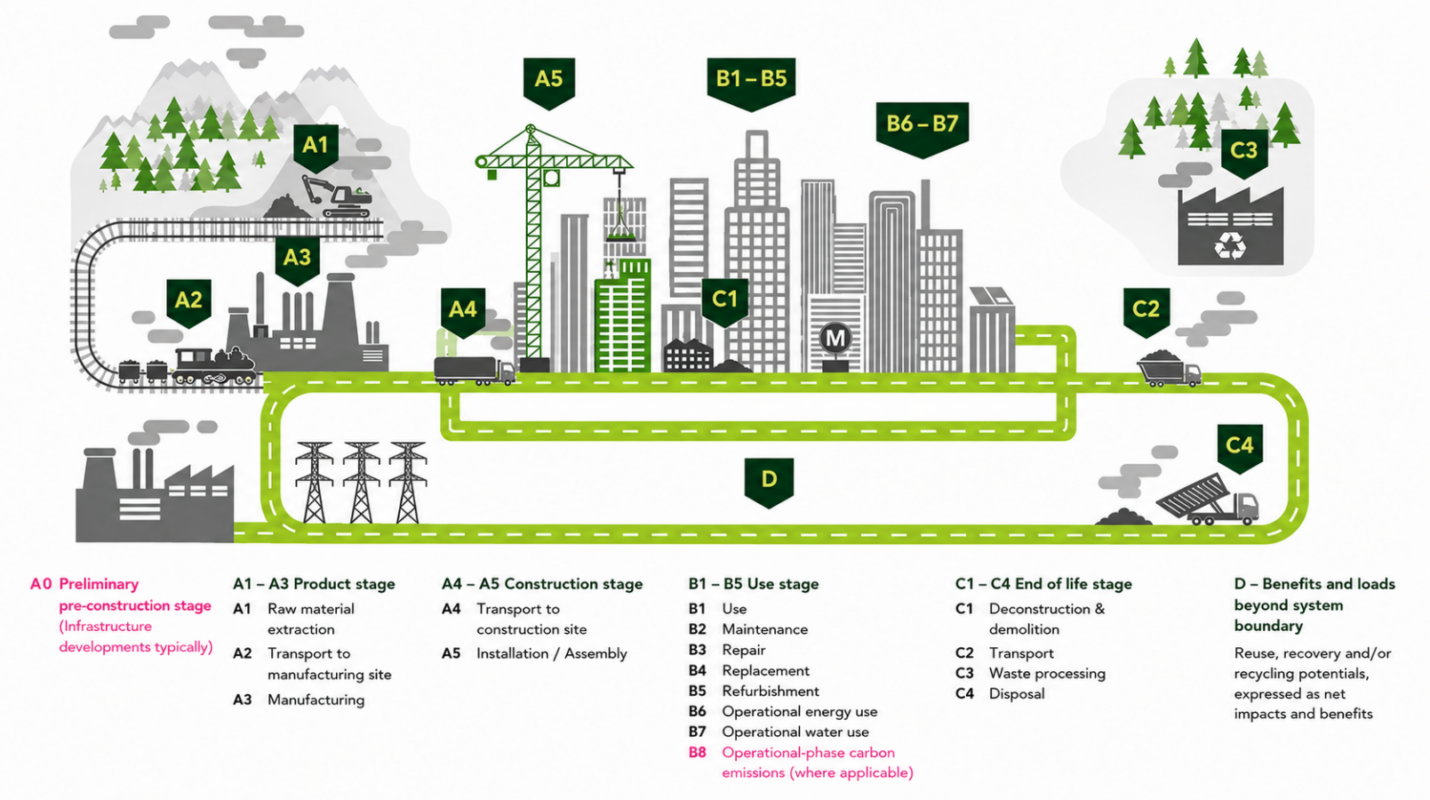
We’ll also demystify the life-cycle modules A1–A5, B1–B7, C1–C4 and D, explaining what is actually being measured at each stage.
For example, embodied carbon doesn’t stop when construction finishes. It can include maintenance, repair, replacement, refurbishment and ultimately demolition and disposal.
Same building. Different carbon requirements.
One of the areas that causes the greatest confusion is that an assessment may be requested for several different reasons.
A project might require an assessment under:
- RICS Whole Life Carbon Assessment methodology
- BREEAM
- Local planning policy
- UK Net Zero Carbon Buildings Standard
- ESG, investor or corporate carbon reporting
Although these approaches often share the same underlying life-cycle principles, the required scope, reporting, benchmarks, project stages and purpose can differ.
Understanding why the assessment is required before starting it is therefore essential.
What does this mean for Winchester developments?
The session will specifically look at Winchester Policy CN8 – Embodied Carbon and what this means for local development teams.
We’ll examine what needs to be calculated, what information is expected through the planning process and how the findings of the embodied carbon assessment can be used to demonstrate that carbon has genuinely been considered during design.
This isn’t simply about producing another number for a planning report.
The value of carrying out an assessment early is the opportunity to identify carbon hotspots, compare options and influence the design while there is still time to change it.
Book a session for your team
Our first session will be available on:
- Tuesday 15 September 2026
- 12:30 pm
- Approximately one hour
- BOOK: https://events.teams.microsoft.com/event/4cbeb564-0d63-469f-8e3b-10f76b8f16d3@f209b708-3168-434e-97c0-bce69839fb23
Rather than asking teams to travel to us, SEES can come to your office in the Winchester area and deliver the session to your team over lunch. The training is aimed at architects, planning consultants, developers, contractors and other professionals who want a practical understanding of embodied and whole-life carbon without needing to become carbon assessors themselves.