

Home > Blog > EPC Reform Response: Progress… But Government Missed a Trick
EPC Reform Response: Progress… But Government Missed a Trick
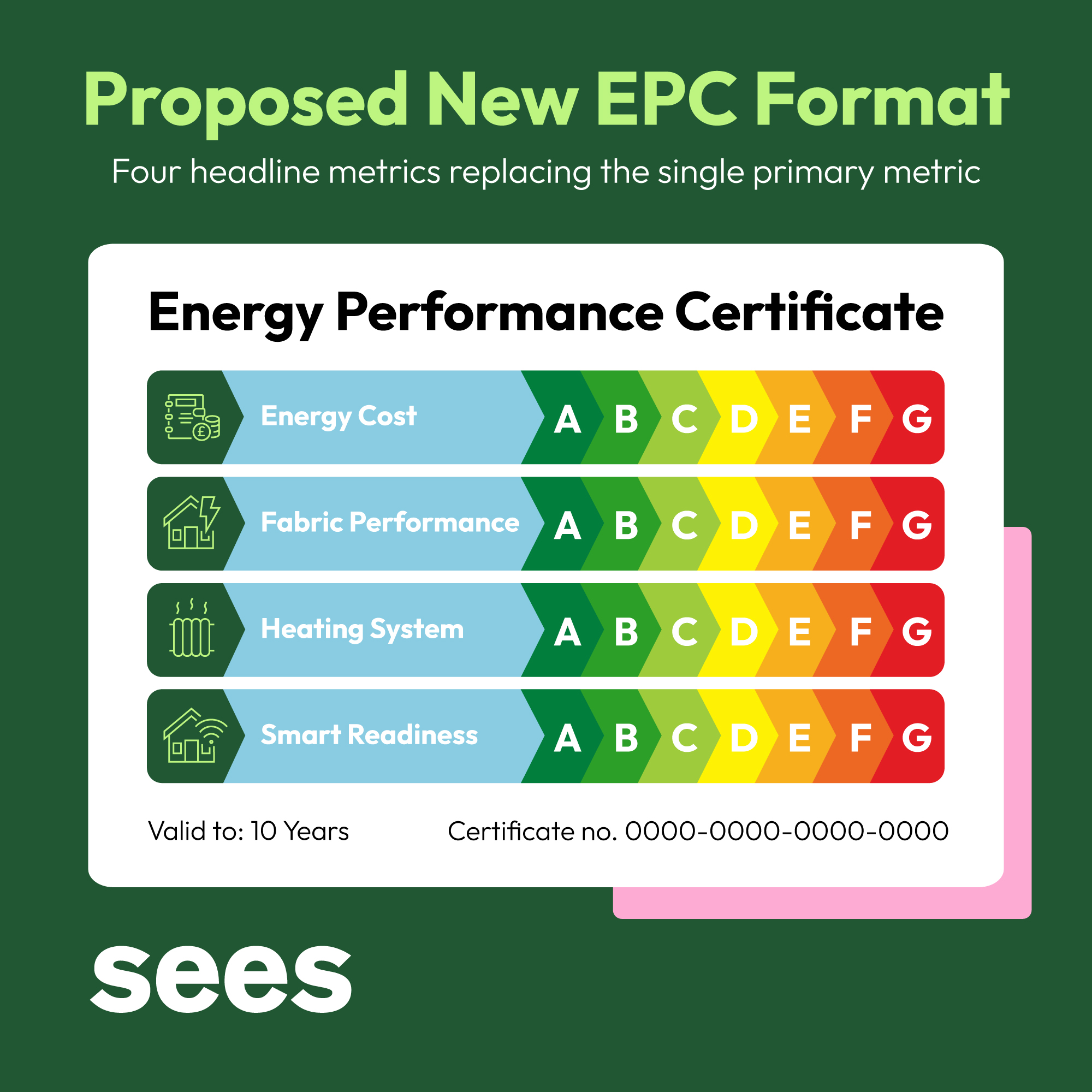
The Government’s partial response to the proposed EPC reforms signals real movement — but also leaves some big gaps that the industry has been shouting about for years. At SEES, we support clients with building performance, compliance and sustainability strategy — so when EPC reform is on the table, we pay attention. Here’s what’s changing, what’s missing, and what it means for property owners, landlords, holiday let operators and heritage buildings.
For support with EPC strategy, retrofit planning and compliance advice, visit: https://sees.co.uk/services/retrofit/
The headline change: EPCs will show FOUR metrics
Government has confirmed that domestic EPCs will be updated to include four headline metrics, replacing the single cost-based approach:
- Energy cost
- Fabric performance
- Heating system
- Smart readiness
This is a step forward. It should make EPCs far clearer and reduce the “one rating hides all sins” problem.
Government also intends to include:
- a secondary energy demand metric (delivered energy)
- retain a secondary carbon metric
- and keep the legacy EER metric for comparability with existing EPCs and regulations
Translation? EPCs are being redesigned to explain why a building performs the way it does — not just give it a score and walk away.
Missed trick: Water is STILL not included
Yes, EPC reform is happening… but water efficiency still isn’t a headline metric. This matters because buildings don’t just consume energy — they consume utilities, water too has a CO2 footprint! If EPCs are meant to guide improvements, water has to be part of that conversation.
Waterwise (https://waterwise.org.uk/) have previously called for water to be included on EPCs, and at SEES we fully support that position.
We’ve been talking about this for a while now — and if we’re being honest, it’s one of the easiest “common sense wins” EPC reform could deliver.
EPC validity stays at 10 years
EPCs will still remain valid for 10 years.
That’s a long time in a world of:
- constantly changing energy prices
- retrofit acceleration
- upgraded standards
- heat pump rollouts
- tightening expectations for landlords and portfolios
A decade can turn a “fairly accurate EPC” into a historical document. (And not the useful kind.)
EPC required earlier: “point of marketing”
A practical compliance change is that Government intends to require EPCs at the point of marketing.
That’s significant. It means EPCs can’t be left until the last minute — the property needs a valid EPC ready before it’s listed.
Big scope changes: HMOs, holiday lets and heritage buildings
This is where the partial response really matters — because it affects far more properties than people realise.
HMOs: EPC required for the whole building
Government intends to clarify EPC requirements so where individual rooms are let in an HMO, there must be a valid EPC for the entire property.
Holiday lets / short-term rentals: EPCs will apply
Government intends to require short-term rental properties (including holiday lets) to have a valid EPC regardless of who pays the energy bills.
This is a big shift — and likely to catch some operators off-guard.
At SEES, we expect this to become a growing compliance issue for holiday let owners and agents, especially where buildings are:
- intermittently occupied
- older / harder to upgrade
- not operated like a conventional “home”
Heritage buildings: exemption removed
Government intends to remove the existing exemption for heritage buildings, meaning an EPC will be required when these buildings are marketed, sold or let.
That will be particularly relevant for:
- listed buildings
- traditional construction
- buildings with conservation limitations
There are very real risks here if EPC advice and improvement recommendations aren’t handled properly — because “best practice retrofit” and “heritage-safe retrofit” are not always the same thing.
Smart meters + EPCs: the future could be smarter (finally)
Government also references interest in smart meter-enabled approaches (including SMETERs) and invites further views on how this could work.
This is where EPCs could become genuinely useful: less prediction, more evidence. And it’s another reason we believe EPCs should ultimately evolve to reflect all utility use, not just energy.
What happens next?
This is a partial response, and Government states the full consultation response (including other EPB areas) will be published in 2026, with regulations intended from 2026 onwards, subject to parliamentary approval.
Given the timelines, it’s reasonable to assume EPC reform could align with wider updates such as the Home Energy Model (HEM) transition and the next wave of regulatory expectations.
SEES view: better EPCs are coming — but let’s do it properly
The move to four headline metrics is the right direction.
But EPCs won’t become the tools we need unless they:
- reflect real building performance
- drive the right retrofit priorities
- work properly for heritage and complex buildings
- apply clearly across HMOs and short-term lets
- stop ignoring water
Need help navigating EPC changes?
If you’re a homeowner, landlord, developer, managing agent, or holiday let operator and want clarity on what these reforms mean for your property (and what to do next), SEES can help.
Visit sees.co.uk to learn more, or contact us for building performance and compliance support.